Order before 2pm for UK next day shipping | US | EXPORT

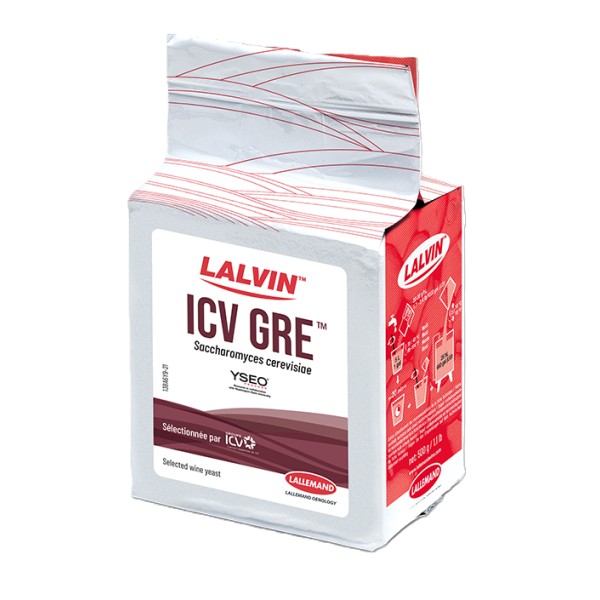
Lalvin ICV GRE Yeast (YSEO) (500g)
A new generation of wine yeast that gives the freedom to express the sensory potential of varietal white wine.
Availability:
In stock
SKU
WY-ICV-GRE-500G
The selection of Lalvin Sensy was largely made possible through a collaborative study between the ICV Group, Lallemand oenology, SupAgro and INRA Montpellier. This study, using the QTL technique (Quantitative Trait Loci), was used during the thesis: Identification of the molecular basis of technological properties of wine yeast (Jessica Noble, Advisor: Bruno Blondin, 2011).
This work resulted in a patent application filed by INRA and Montpellier SupAgro: Method of control on the production of sulphites, hydrogen sulphur and acetaldehyde by yeast ( Variants MET2 / SKP2).
This approach has enabled the development of an innovative selection technique for yeast which produces low levels of SO2, H2S and acetaldehyde.H2S confers negative aroma attributes to wine.
It can be considered as a real issue especially for varietal white wine, as it generates unacceptable quality loses and masks aroma flavour. Lalvin Sensy will produce no or very little H2S which is a great advantage to express varietal aroma from white grape varieties.
The low acetaldehyde production by Lalvin Sensy will be a good asset to stabilise wines through moderates SO2 use.
Lalvin Sensy gives more open wines whereas wine fermented with other yeast show more reductive notes and. has the capacity to enhance mouthfeel structure.
Microbial and Oenological Properties
Recommended for white wine production.
Saccharomyces cerevisiae var. cerevisiae
Very good implantation
Very short lag phase
Complete to regular fermentation rate
Alcohol resistance: up to 15%
Temperature tolerance: 12 to 18C
Low requirement for assimilable nitrogen
Low H2S whatever fermentation environmental conditions
Very low SO2 production
Low volatile acidity production (< 0.35 g/L) Low acetaldehyde production Contributes to enhancing varietal aroma Very good mouthfeel
| Vegan | No |
|---|
Need technical advice?
Find all the your TDS and SDS here.
Talk to the people in the know by calling one of our qualified brewers and winemakers on 0115 978 5494


Murphy & Son, Alpine Street, Old Basford, Nottingham, NG6 0HQ, United Kingdom.
Murphy & Son Ltd | 0115 978 5494 | Legal Pages